Here I show an application developed by the IDEAbuilder Tech Tools team. The team created an application using actual digital fabrication models (the same 3D computer aided manufacturing models that drive our CNC machines) combined with a 3D city model created with ESRI's City Engine tool and viewed using the Oculus Rift head mounted display for an immersive virtual reality AEC (Architecture, Engineering, Construction) experience.
Friday, May 10, 2013
Friday, April 26, 2013
Getting all up in your Z space
This past week I experienced zCon, the conference for Infinite Z's zSpace device. zSpace is an immersive, interactive hardware and software platform for developers and users allowing interaction in a true 3D holographic-like environment. zSpace works with most standard and off-the-shelf computers so that anyone can transform a PC into a virtual-holographic computing system.

Users working in zSpace wear lightweight passive polarized eyewear and use the zSpace stylus — which feels like a normal ballpoint pen. When examining an object in zSpace, users get a realistic sense of its depth and volume. One can rotate the object or move their head around the object to see it from multiple angles.
It is a cool sensation when pulling something 'out of the screen', but I noticed most people at the conference had to be informed that this was possible.
zSpace even includes a virtual camera that users can move to visualize objects from different perspectives or even place inside objects to review and examine the inside and internal content of objects. It currently only works with one user at a time, but its applications can be multiuser.
Held at the Computer History Museum in Mountain View, zCon2013 was the first ever developer conference for this device. zCon is an educational environment that stimulates communication and collaboration among developers of 3D applications, hardware and content who are interested in immersive, lifelike and interactive technologies. There were over 45 sessions in technical/user experience, research/academia, and business oriented tracks and over 50 industry leaders including application developers from companies like zSpace, Autodesk, Solidworks, and Siemens.
Unfortunately I could only attend for the first day, but what a day it was. I saw a few old friends and made some new ones. The first day keynotes were among the best I have witnessed ever. The morning keynote from Academy Award-Winning Producer Jon Landau (Titanic, Avatar) was entertaining and the afternoon one by Mark Kassen (Filmmaker, Playwright and Actor) included a super engaging short movie that he provided live narration for. The presentations were informative and I learned of a variety of exciting applications that are using the zSpace device. Our company CTO even won a device at the event!
zCon2013 was a nice event and I look forward to seeing how it and the zSpace community grow.
Users working in zSpace wear lightweight passive polarized eyewear and use the zSpace stylus — which feels like a normal ballpoint pen. When examining an object in zSpace, users get a realistic sense of its depth and volume. One can rotate the object or move their head around the object to see it from multiple angles.
It is a cool sensation when pulling something 'out of the screen', but I noticed most people at the conference had to be informed that this was possible.
zSpace even includes a virtual camera that users can move to visualize objects from different perspectives or even place inside objects to review and examine the inside and internal content of objects. It currently only works with one user at a time, but its applications can be multiuser.
Held at the Computer History Museum in Mountain View, zCon2013 was the first ever developer conference for this device. zCon is an educational environment that stimulates communication and collaboration among developers of 3D applications, hardware and content who are interested in immersive, lifelike and interactive technologies. There were over 45 sessions in technical/user experience, research/academia, and business oriented tracks and over 50 industry leaders including application developers from companies like zSpace, Autodesk, Solidworks, and Siemens.
Unfortunately I could only attend for the first day, but what a day it was. I saw a few old friends and made some new ones. The first day keynotes were among the best I have witnessed ever. The morning keynote from Academy Award-Winning Producer Jon Landau (Titanic, Avatar) was entertaining and the afternoon one by Mark Kassen (Filmmaker, Playwright and Actor) included a super engaging short movie that he provided live narration for. The presentations were informative and I learned of a variety of exciting applications that are using the zSpace device. Our company CTO even won a device at the event!
zCon2013 was a nice event and I look forward to seeing how it and the zSpace community grow.
Tuesday, February 19, 2013
Fashion Technology is the New Black
One thing I thoroughly enjoy is seeing the many ways that technology is changing the industries of the world. I often venture to various industry meetups in SF and abroad to see how early adopters and innovators use tech to evolve what they do. Over the years, I have become a spectator of how tech is evolving the fashion industry. Sure I can use any fashion tips I can get, a guilty pleasure is watching Project Runway (I am a fan of Heidi Klum & Tim Gunn), and let's not forget this is a global trillion dollar industry.
The fashion industry consists of four levels: the production of raw materials, principally fibres and textiles but also leather and fur; the production of fashion goods by designers, manufacturers, contractors, and others; retail sales; and various forms of advertising and promotion. These levels consist of many separate but interdependent sectors, all of which are devoted to the goal of satisfying consumer demand for apparel under conditions that enable participants in the industry to operate at a profit. - Wikipedia
There are many impressive fashion tech applications I have been exposed to and here are some of my favorites that leverage more innovative technologies.
Bodymetrics :
Developed by Bodymetrics, a London-based pioneer in 3D body-mapping, the Bodymetrics Pod was introduced to American shoppers for the first time during Women’s Denim Days at Bloomingdale’s in Century City, Los Angeles. This is the first time Kinect for Windows has been used commercially in the United States for body mapping in a retail clothing environment.
Bodymetrics has also made a solution for the living room that can be seen in the video below.
Fits.me :
Fits.me Virtual Dressing Room has applied advanced robotic science to solve the problem of ‘the wrong size’ for online clothes shoppers. At the heart of Fits.me’s virtual fitting room is ‘FitBot’, a sophisticated robotic mannequin with artificial muscles able to mimic the shape and size of any body type – almost 100,000 different shapes.
To populate the database of any given brand or retailer, a FitBot is dressed in each item of clothing, in each size. Each permutation is then photographed at high speed, in high resolution, while the FitBot runs rapidly through its thousands of different body shapes. Then, on the brand or retailer’s site, after asking a shopper to enter just a few basic measurements, Fits.me is able to display the garment pictures that correspond exactly to his/her body shape. The customer sees exactly how the garment in the range, in any of the available sizes, will hang on them (or cling to them), and all before making their online purchase.
Mintperfect :
The startup Mintperfect leverages elements of HTML5 to allow shoppers to view and examine the recreations of the clothes they want to purchase in 3D with no plugin needed. I have not heard much about this startup beyond the event I met the founder at, but am a fan that it is the first use of WebGL for the fashion industry I have seen.
Styku :
A product of the Microsoft Accelerator for Kinect program, Styku, has developed virtual fitting room software and body scanner technology powered by Kinect for Windows. Styku has pioneered a precise apparel fit and size prediction and visualization platform that is poised to revolutionize the way people shop for clothing. The Smart Fitting Room is designed to overcome the hurdle in online apparel sales for the online retailer; the inability to “try before I buy”.
Decoded Fashion at Mercedes-Benz Fashion Week
While visiting New York, I got the opportunity to attend Decoded Fashion and its hackathon finale. The show featured movers and shakers of the fashion world that included fashion model Coco Rocha and designer Zac Posen.
I was impressed by the amount of fashion applications that used technologies close to my heart.
First up was AHAlife and their augmented reality campaign that used the Layar platform.
Next was SayDuck, a startup company based in London and Helsinki. They provide a mobile augmented reality platform for showcasing products like furniture, home decorations, and fashion accessories.
.
Finally, there was a panel about fashion and 3D printing with a representative from Shapeways. For those that don't know, Shapeways is a 3D printing marketplace and community. It has quite an impressive gallery of designs from fashion designers.
New York based fashion designer Kimberly Ovitz took the idea of natural defense, an exoskeleton, and brought it to Shapeways. She created a fluid, organic jewelry collection that molds to the body like armor. During New York Fashion Week, Kimberly presented her first jewelry line that you can buy straight from the Fall 2013 runway, custom made for the buyer.
Bravo fashion industry players. I applaud your fashion tech forward thinking and will be keeping my eye on you. For those that want to stay current with fashion tech news, I recommend the SF FashTech Blog.
There are many impressive fashion tech applications I have been exposed to and here are some of my favorites that leverage more innovative technologies.
Bodymetrics :
Developed by Bodymetrics, a London-based pioneer in 3D body-mapping, the Bodymetrics Pod was introduced to American shoppers for the first time during Women’s Denim Days at Bloomingdale’s in Century City, Los Angeles. This is the first time Kinect for Windows has been used commercially in the United States for body mapping in a retail clothing environment.
Bodymetrics has also made a solution for the living room that can be seen in the video below.
CLO Virtual Fashion Inc. :
CLO Virtual Fashion Inc. is based in Seoul and its products are used by designers in industries like fashion, gaming, and education to create realistic, digital 3D clothes. Marvelous Designer and CLO3D are software tools that allow for the design of accurate patterns without the help of the other pattern CAD tools, and provide realistic clothing simulation animations so designers can see how their designs look and move on a virtual model. CLO3D is a 3D virtualization tool and supports 2D pattern file load, avatar size change, and the other features like stitch line.
Marvelous Designer is mainly for animations, game, and commercial use and is compatible with other 3D tools including Maya, 3Ds Max, Maxon and other modeling tools. Marvelous Designer 2 was used in the Hobbit movie.Fits.me :
Fits.me Virtual Dressing Room has applied advanced robotic science to solve the problem of ‘the wrong size’ for online clothes shoppers. At the heart of Fits.me’s virtual fitting room is ‘FitBot’, a sophisticated robotic mannequin with artificial muscles able to mimic the shape and size of any body type – almost 100,000 different shapes.
To populate the database of any given brand or retailer, a FitBot is dressed in each item of clothing, in each size. Each permutation is then photographed at high speed, in high resolution, while the FitBot runs rapidly through its thousands of different body shapes. Then, on the brand or retailer’s site, after asking a shopper to enter just a few basic measurements, Fits.me is able to display the garment pictures that correspond exactly to his/her body shape. The customer sees exactly how the garment in the range, in any of the available sizes, will hang on them (or cling to them), and all before making their online purchase.
Mintperfect :
The startup Mintperfect leverages elements of HTML5 to allow shoppers to view and examine the recreations of the clothes they want to purchase in 3D with no plugin needed. I have not heard much about this startup beyond the event I met the founder at, but am a fan that it is the first use of WebGL for the fashion industry I have seen.Styku :
A product of the Microsoft Accelerator for Kinect program, Styku, has developed virtual fitting room software and body scanner technology powered by Kinect for Windows. Styku has pioneered a precise apparel fit and size prediction and visualization platform that is poised to revolutionize the way people shop for clothing. The Smart Fitting Room is designed to overcome the hurdle in online apparel sales for the online retailer; the inability to “try before I buy”.
Decoded Fashion at Mercedes-Benz Fashion Week
While visiting New York, I got the opportunity to attend Decoded Fashion and its hackathon finale. The show featured movers and shakers of the fashion world that included fashion model Coco Rocha and designer Zac Posen.
I was impressed by the amount of fashion applications that used technologies close to my heart.
First up was AHAlife and their augmented reality campaign that used the Layar platform.
Next was SayDuck, a startup company based in London and Helsinki. They provide a mobile augmented reality platform for showcasing products like furniture, home decorations, and fashion accessories.
.
Finally, there was a panel about fashion and 3D printing with a representative from Shapeways. For those that don't know, Shapeways is a 3D printing marketplace and community. It has quite an impressive gallery of designs from fashion designers.New York based fashion designer Kimberly Ovitz took the idea of natural defense, an exoskeleton, and brought it to Shapeways. She created a fluid, organic jewelry collection that molds to the body like armor. During New York Fashion Week, Kimberly presented her first jewelry line that you can buy straight from the Fall 2013 runway, custom made for the buyer.
Bravo fashion industry players. I applaud your fashion tech forward thinking and will be keeping my eye on you. For those that want to stay current with fashion tech news, I recommend the SF FashTech Blog.
Links to this post
No comments:
Posted by
Metaverse One
at
9:32 PM
Labels:
ahalife,
augmented reality,
bodymetrics,
clo3d,
coco rocha,
decoded fashion,
fashion,
fits.me,
kimberly ovitz,
kinect,
layar,
marvelous designer,
mintperfect,
project runway,
sayduck,
shapeways,
styku,
zac posen
Friday, February 1, 2013
First Choice Cola’s Free Ride – Augmented Reality Facebook game
So I am visiting the Netherlands and got a chance to check out this augmented reality Facebook application called Free Ride. It launched a couple weeks ago and was developed for YoungWorks by my friends at The Young Generation (TYG).
I applaud TYG for their clever use of augmented reality here. This Flash-based snowboard game uses a custom beanie that has an embroidered fiducial marker to control the snowboarder. Moving side to side controls the direction of the snowboarder and leaning forward or back controls the speed.
My Dutch isn’t the greatest, actually I don’t know any, so expect a follow up interview explaining more about the application from a member at The Young Generation soon.
The Young Generation is a full service digital agency that specializes in concept, design, strategy, and production of interactive campaigns. I look forward to seeing what killer games and interactive campaigns they come out with next.
I applaud TYG for their clever use of augmented reality here. This Flash-based snowboard game uses a custom beanie that has an embroidered fiducial marker to control the snowboarder. Moving side to side controls the direction of the snowboarder and leaning forward or back controls the speed.
My Dutch isn’t the greatest, actually I don’t know any, so expect a follow up interview explaining more about the application from a member at The Young Generation soon.
The Young Generation is a full service digital agency that specializes in concept, design, strategy, and production of interactive campaigns. I look forward to seeing what killer games and interactive campaigns they come out with next.
Monday, January 28, 2013
SimLibrary - When Danish Libraries Go Digital
Over the past few years I have been engaging a lot more with various entities in Denmark. One such group that has recently caught my attention is the Danish library system. Now I do remember coming across this report years back about the city of Aarhus Main Library's Transformation Lab and being impressed.
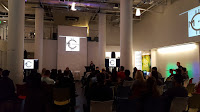
Recently Dave Arendash, CTO at SpiralConcepts, and I were invited to present at SimLibrary, an event highlighting mixed reality technologies for libraries, held in Odense, Denmark.
From the SimLibrary Website (translated from Danish): SimLibrary is a cooperation between Odense Central Library, Aalborg, and Herning libraries with Euman A / S, and Educational Media Centers in the project cities. The SimLibrary project aims to develop libraries to a prominent place in the digital experience community with young people as drivers in a user-driven innovation process. To create virtual and physical environments that encourage young people to form relationships. The goal is to develop new delivery of physical and virtual library spaces by incorporating the Playingmondo 3D platform and create user-driven innovation processes in SimLibrary, with young people ideas as the basis for new library services. The project is based on user-driven innovation by young people actively involved in building the 3D world, SimLibrary and helps to create the library space, in a combination of physical presence and online communications.
3D Mixed Reality Gaming Work on the Playingmondo platform can be used for virtual playgrounds and play spaces where mobile technology, GPS and broadband used to support physical play and games as well as use and highlight local area spaces. 3D technology makes it possible to mix reality and the virtual world. The technology opens up entirely new possibilities for e-learning and provides unique opportunities to motivate movement in nature, urban or indoor. 3D gaming technology makes it possible to test concepts before they are created, making it a great interactive tool for user involvement in construction or upgrading of existing structures and facilities. 3D technology for mobile can make the virtual experience in a natural setting more realistic and lifelike. Mixed reality gaming is tool and teaching materials that support the need for delivery of "text" to the context and coherence in the movement around the many ude-/inderum (spaces / contexts).

Mixed reality gaming is also learning for children who use the children's reality - computer games and social media - as a tool and medium for learning. When mixed reality gaming based on game or competition in a good way and in the children's universe, the students are constantly measured and weighed as a natural part of learning.
Development of a 3D model of a library can provide a basis for such the following applications: Ability to learn library better to know in advance Users of the library can use the 3D model on a web page to orient themselves and navigate the library before a visit. Users can play the library's existing Playingmondo games and themed walks by in 3D on the Web to move around with the keyboard and mouse and activate the items and effects. Play multiplayer games on mobile and web users will be able to play multiplayer Playingmondo game.
In 3D on the Web, some players move around with the keyboard and mouse and activate the items and effects, while opponents or team-mate moving physically around the library with mobile phone and activate game elements. Interact with the library in new ways can imagine that library users can interact with library staff, visitors, and facilities at the library in new ways. Examples may be that virtual home can visit the library via web-based 3D version, go to a shelf, take a book out and look at it and possibly, the book. It can also contribute to social interactions between library users who are physically present (with cell phone) and those who sit at home or at school in front of the computer.
In our presentation, we outlined a variety of new technologies that are making their way to the mainstream, and our ideas of how they can be used to create a new type of library experience. Dave also showed an augmented reality example he created where a video about Deepak Chopra's new book played on the cover of the book once the camera saw it. Our presentation was a big hit, and I am very thankful I got the opportunity to participate.
The video I made on slide 11:
More information on the SimLibrary workshop can be found here. I recommend visiting the site with Google's Chrome web browser as it will translate the site from Danish to your preferred language.
Wednesday, December 19, 2012
A Leap into the holidays
So the developer kits for the Leap Motion gesture control device shipped a few months back and now we are starting to see a variety of Leap developer videos make it on the web.
AirHarp
Block 54
Leap Motion and Unity3D experiment
AirHarp
Block 54
Leap Motion and Unity3D experiment
Subscribe to:
Posts (Atom)